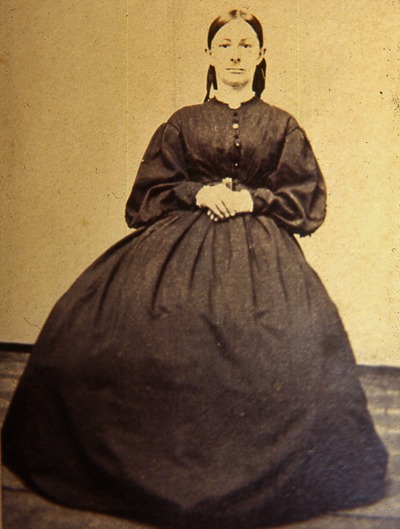
Susan Mary Edelen was born on September 28, 1833 in
Clear Spring (or Clearspring, as it was known at the
time), Washington County, Maryland, a small village 11
miles west of Hagerstown. She was the first child of
Charles and Elizabeth (Ridenour) Edelen and was
apparently named for her maternal grandmother. Her
father was born in Virginia in 1797 and moved to Clear
Spring as a young man. Susan's mother, Eliza, as she
was known, was born August 30, 1806, the daughter of
Samuel and Susan Ridenour.
2
Charles Edelen was a devout member of the Presbyterian
Church and Eliza was a Lutheran.
3
They were married on April 9, 1829 by Rev. Kurtz at
St. John's Evangelical Lutheran Church in Hagerstown,
Maryland. During the 1840's Charles Edelen became a
very successful merchant in Clear Spring and acquired
several valuable properties. On February 1, 1840 he
bought the property at 137 Cumberland Street from
Jacob and Elizabeth Loose for $1000.
4
Cumberland Street is the main street through Clear
Spring and is also part of the Cumberland (or
National) pike running from Baltimore to St. Louis.
Traffic was heavy with western expansion and the
Edelen store was soon doing substantial business at
this location. Two years after buying the store he
bought a slave, Esther Moody, from George Bragonier.
5 Esther was
twenty-two years of age and came with her two
children, Catherine (or Cass) age 4, and Samuel age
2. Mr. Edelen paid $314.12½ for them, but only
kept them for about 2 years. In 1844 he sold them to
Green H. Duke for $450.
6
That same year he bought an eleven-acre farm named
"Kindness Enlarged" from Lancelot Jacques,
7 trustee of Denton
Jacques. Located southwest of town on Cove Road,
"Kindness Enlarged" was one of the earliest land
patents in the area and the Jacques family was one of
the first to settle there. Also in 1844, Mr. Edelen
bought 170 acres and 20 perches from the heirs of
Thomas Prather
8, and in
return sold 9 and 13/16 acres from "Kindness Enlarged"
to Richard Prather. On June 14, 1847, Charles Edelen
received the deed to a house on North Mill Street,
next to the Methodist Episcopal Church.
9
Altogether, by 1850 Susan's father owned real estate
valued at $16,000, according to the federal census for
that year. In addition to Susan, the Edelen family
included the following children: Sarah E. Edelen, born
March 7, 1836; Charles C. Edelen, born July 27, 1837;
John S. Edelen, born in 1840; Amelia E. Edelen and
Margaret A. Edelen, apparently twins born about August
20, 1843;
10 and Denton
Jacques Edelen, born December 28, 1845. All of the
Edelen children were scholars at the Clearspring
Academy.
The
Clearspring
Academy was founded soon after Susan was born
and was typical of the private schools that were
springing up all over the country. Following the
American Revolution the academies combined the
classical studies of Greek and Latin with practical
mathematics and science based upon a model attributed
to Benjamin Franklin. Prior to the emergence of public
high schools they brought more advanced education to
the middle class than the "common" schools of the day.
Susan probably began her studies at the Academy at
about the age of six. The first page of her school
manuscript is dated March 4, 1843 when she was nine,
by which time she was already highly skilled at
penmanship. The Academy is said to have had very high
academic standards and encouraged neatness. (At one
point, apparently dissatisfied with her penmanship,
she places the blame on "a very bad pen".) One
historian states that in some of the local schools the
students' notebooks were collected and graded,
although there is no indication of that in Susan's
manuscript. Many of Susan's pages contain highly
embellished lettering in the titles, which are often
hand-colored. Judging from the clarity and lack of
erasures throughout the sometimes tedious page-long
mathematical calculations, she had little difficulty
with the subject.
So, Susan's childhood was in no way deprived. She
lived in a typical middle class environment in rural
western Maryland. Her father owned several valuable
properties and was very well-established in the
community. The family, moderately large by the
standards of the day, was well provided for and had
the benefits of a quality education. Perhaps the most
insight into who Susan was at this time in her life
can be found in the poetry that she included with her
math assignments, especially the later poems that she
wrote just after finishing her studies at the Academy.
Susan's literary interests did not end when she
graduated from the Clearspring Academy. She was
apparently reading the literary journals of the time,
including Graham's Magazine and The Flag of Our Union
from which she included poems in her manuscript.
Indeed, upon her death nearly sixty years later she
would be remembered as "a woman of fine Christian
character and literary attainments".
11
Unfortunately, aside from this tantalizing comment, no
other information on her literary life has survived.
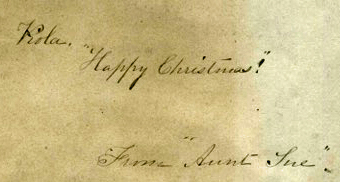
One clue, however, is found in a small Victorian
scrap
album that she gave to her niece, Miss Viola
Snyder. It is inscribed in Susan's delicate hand:
Judging from the contents of the album the year was
about 1881, when Miss Viola would have been about
fourteen years old.
12
The scrap album contains a diverse assortment of
poetry and prose, some of which may have been
collected by Susan herself. (But, alas, none of them
is explicitly ascribed to her.) Susan may have been a
member of one of the numerous literary societies that
sprang up throughout the county in the last quarter of
the nineteenth century. These societies "served the
middle and upper class women just beginning to enjoy
their first taste of leisure time, but such luxury was
available to the women who lived in towns and villages
rather than on farms."
13 Local
residents recall that there was at least one such
society in Clear Spring.
It is not known what occupied Susan (or "Sue", as she
preferred to be called from this time on) during the
eight years between her graduation from the Academy
and her marriage. One of her fellow Academy scholars,
Miss Ann Elizabeth Grosh, who was the same age as
Susan and later became her sister-in-law, became a
teacher and returned to the Academy in that capacity.
Perhaps Susan followed a similar course by attending
one of the "female seminaries"
14,
or perhaps she remained at home to help care for her
younger brothers and sisters.
 Courtesy of Clear Spring District Historical
Association
Courtesy of Clear Spring District Historical
Association
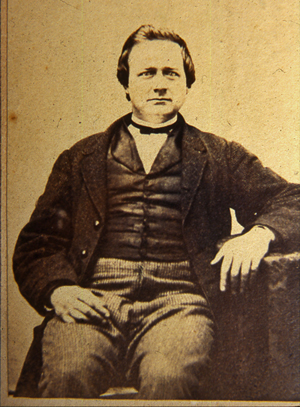
John T. Snyder
On November 9, 1858 Susan married John Thomas Snyder,
a merchant in Clear Spring. John had grown up in Clear
Spring and was about three years older than Susan. In
1850, at about the time Susan was writing her later
poems, he was a store keeper living with Jonathan
Loose, who was also a merchant in Clear Spring. The
Loose store, located at 148-150 Cumberland street, was
almost directly across the street from Susan's
father's store. On April 7, 1855 Otho Nesbitt recorded
in his diary: Loose and John Snider [sic] have gone
into partnership. Susan probably had known John all
her life and they may even have been classmates at
Clearspring Academy. It is curious, then, that they
did not decide to marry sooner. Perhaps he wasn't her
first choice. If the "thee" whom Susan is addressing
in her last two poems was anyone other than John T.
Snyder, then it may have taken her those intervening
eight years to mourn the loss of that first love. The
following biographical sketch describes the life and
career of John T. Snyder:
15
John T. Snyder was born on Poplar Hall
farm, in Clearspring District, August 6, 1830; he
died August 23, 1895. He was the son of Leonard
Snyder, a farmer of Clearspring District, who lived
on the Poplar Hall farm, now the property of his
grandsons, Charles L., William F. and J.O. Snyder.
Leonard Snyder died young, leaving his son, John T.,
a small boy and without means. The lad came to the
town of Clearspring, and began as a clerk in the
store of Jeremiah Mason and Jonathan Loose; he
remained in the same employ until he was of age.
Meanwhile, by honesty, integrity, and sober and
temperate habits, joined with industry, he had
accumulated a small capital and on April 1, 1860, he
entered into a partnership in the general
merchandise business, at Clearspring, under the firm
name of Snyder & Bovy. About two years later,
the firm name was changed to Snyder & Miller,
and so continued until about 1888, when Mr. Snyder
bought out the interest of his partner, Mr. Miller,
and took in his son, Charles L. Snyder, giving the
new firm the name which it still bears. Beginning
business life as he did, without a dollar, the
uniform success and high reputation of John T.
Snyder were due alone to his courage, activity and
good management. He was still active and prosperous
at the time of his death. Besides the largest
general store in Clearspring, he owned several
hundred acres of fine arable land in the district;
he was a director in the Steam Engine and Machine
Company, and a stockholder in the County
Agricultural Society, and in the First and Second
National Banks of Hagerstown. His politics were
always Democratic, but he never aspired to any
public office.
Susan recorded in the family Bible "John T. Snyder, my
beloved husband died 23d August, 1895, aged 65 years
and 17 days". At that time he was described as "one of
the wealthiest men in the county. . . . He owned
several farms in the Clear Spring district and his
judgement and opinion on matters pertaining to
agriculture have always been highly regarded and
sought after by those who knew him".
16
His death was attributed to diabetes, but was brought
on by "malarial chills" suffered in response to the
death of their daughter, Eva, the preceding May.
During his last illness perhaps Susan recalled the
lines of "To the afflicted one", the first poem in her
manuscript written over half a century earlier. John
T. Snyder is buried in the family plot in Little Rose
Hill cemetery, east of Clear Spring.
John T. and Susan Snyder had a total of five children:
Charles Leonard Snyder, August 24, 1859 to
July 27, 1927. Upon the death of his father, Mr.
Charlie took over the management of family store,
John T. Snyder & Son.
Mary Virginia Deaver Snyder, February 14,
1861 to January 24,1863. Mary V.D. Snyder's life was
grievously short; she only lived 1 year, 11 months
and 10 days, and was probably a victim of small pox.17 Upon recording the
death of her first daughter, Susan wrote a poem in
her family Bible:
We miss our little one; - but she's
sweetly at rest,
The Good Shepherd has folded our lamb to his
breast.
She's gone from our home to a brighter above,
To add one more to His jewels of love.
My Heart is so torn - and, only Thou,
Lord!
Canst comfort, and help me, and true grace afford.
Bind me to Thee by this sweet living tie,
And arm me with faith 'till, I, too, die.
Then, Jesus, remember Thy Mother's pure
love,
She felt for her babe that was born from above,
And let my child when earth's sorrows are past,
Conduct her "mama" to Heaven at last.
William Fiery Snyder, July 29, 1864 to
January 2 1942. Fiery was a partner in the family
store and managed the extensive family farms. He
married Elva Summers and their son, Charles Harold
Snyder, was the only grandchild of John T. and Susan
Snyder
Eva E. Snyder, February 19, 1867 to May 16, 1895.18 She was educated
in Staunton, Virginia and married Philip W. Huff.
One humorous anecdote is recalled of Eva: It is said
that she had accidentaly swallowed her ring.
Everyone told her not to worry and just be patient.
So she was patient and after a time she got her ring
back. But whenever she tried to wear it again,
people would ask if it was the ring that she had
swallowed. Eventually she just couldn't wear it
anymore knowing where it had been. Eva Snyder Huff
died at the age of twenty-eight after a short
illness. The Hagerstown Mail reported that her
brother Charles had gone to visit her about a week
before her death and Susan was already in Roanoke at
her "precious daughter's" side. Eva's untimely death
was a severe blow to the family. Her father took ill
himself as a result and lived for only a few more
months.
Jesse Orion Snyder, June 23, 1869 to February 11,
1941. He was educated in the public schools of Clear
Spring and under a private tutor before attending
Franklin and Marshall College, Lancaster, Pa., from
which he graduated in 1891. He then studied law
under the preceptorship of Gen. H. Kyd Douglas19, of Hagerstown and
was admitted to the bar of Washington County on
December 24, 1892.
As for Susan herself, following the death of her
husband in 1895, she continued to live in the house
next to the family store on Cumberland street. She had
become "The afflicted one" of her first poem,
suffering from severe rheumatism and spending the last
ten years of her life confined to a wheel chair. Susan
spent most of her days in the front room on the second
floor of the tall handsome brick house. Due to the
prosperity of her family and the store, she was
afforded all of the comforts including five or six
wheel chairs, all different styles. An elevator was
also provided for her in the house. Living with her
was her son, Charles L. Snyder who ran the store, and
her niece, Miss Lida Elizabeth Hassett, who had moved
in to care for her.
20
Susan passed away at 1:00 A.M. on Monday, October 7,
1907 at the age of seventy-four. She had been
seriously ill for a week or more. Perhaps during that
time she was able to recall from so many years earlier
the lines of "A dying sister's appeal" for her one
remaining sister, Margaret. The funeral service was
held at the house on the following Wednesday. It was
performed by Rev. E.W. Bald of the Reformed Church,
assisted by the venerable Rev. J.M. Graybill of St.
Peter's Evangelical Lutheran Church. Pallbearers were
several prominent men of the community including Frank
W. Mish, Mayor of Hagerstown. Susan is buried in the
John T. Snyder family plot in the Little Rose Hill
Cemetery of the Reformed Church, east of Clear Spring
along Route 40. With her there are her husband, John
T. Snyder, her three sons, daughter, Eva Snyder Huff,
and grandson Charles Harold Snyder and his wife. Also
buried at Little Rose Hill Cemetery are the families
of two of Susan's sisters, Sarah Edelen Hassett and
Margaret Ann (Edelen) Cowton. The family of John T.
and Susan Snyder is remembered as being very private
and not particularly out-going, although sons Charlie
and Fiery Snyder are both remembered as pleasant
people. Local opinions differ on Jess Snyder, due in
part to his professional dealings as an attorney in
the area. He is credited with acquiring several
valuable properties for the Snyder family. Through the
estate of Charles Harold Snyder, the only grandson and
sole remaining heir of John T. and Susan Snyder, the
legacy of this family is an on-going benefit to the
community. At his death Harold owned five farms plus
one additional lot in Clear Spring District with an
aggregate appraised value of over three million
dollars. In his will he designated that the estate be
distributed among the following charities:
St. John's Evangelical and Reformed
Church, Clear Spring, Maryland
St. Paul's Lutheran and Reformed Church, St. Paul's,
Maryland
Homewood Church Home of the Evangelical and Reformed
Church
Hoffman Orphanage for Children, Littleton,
Pennsylvania
St. Peter's Lutheran Church, Clear Spring, Maryland
Washington County Home for Orphans, San-Mar,
Maryland
American Cancer Society (Maryland Chapter)
American Heart Association (Maryland Chapter)
American Red Cross (Maryland Chapter)