 |
Dick
Martz, His Collection of Horns from
|
 |

 |
More
Info
089 updated:
11/25/2016
|
See also The lurs of the Bronze Age and Music with Bronze Age Lurs
Horn Makers in Denmark
An early maker of brass instruments in Denmark was Johan Christian Stritzky (ca. 1698 - 1752). He was granted a privilege for supplying horns, trumpets, trombones, and some woodwind instruments in 1745, and flourished in Copenhagen from that year until his death on March 11, 1752.
A full generation after Stritzky, the Fasting Family was established as brass instrument makers in Copenhagen by Johannes Fasting (1751 - 1816). He was born in Copenhagen in 1751 and at the age of twenty-four went on a nine-year journey abroad to learn the skills of instrument making. Returning to Denmark he was granted maker's rights in 1787. In 1791 he was penalized for casting brass candelabras, which was outside of his rights as an instrument maker. The penalty was annulled, however and his rights were extended to include brass castings. Fasting was appointed "Hof-Trompet- og Valdhornmager" to the Court in 1793 and that same year made a couple of Inventionshorns for the Royal Orchestra. He was awarded gold medals for improvements to the keyed bugle (1894) and adapting the horn for military use as a bugle (1803). In 1809 he was decorated with the Silver Cross of the Order of the Dannebrog. In 1814 Johannes was succeeded by his son, Johan Jacob Fasting (1789-1847). J. J. Fasting continued the business, producing a trombone and two trumpets for the Royal Orchestra, plus some horns and keyed bugles. Later he partnered with Carl Christian Wilde (1794-1853), doing business as Fasting and Wilde from 1835 to 1847. As early as 1835 the new company was making valved instruments including alto and tenor horns, cornets, and percussion instruments as well. J.J. Fasting was succeeded by Jacob Christian Fasting (1814-1884), who was born in Raadvad, north of Copenhagen. J.C. Fasting's relationship to the previous generations has not been established. He was issued a trade license on August 28, 1848 and went into partnership with Carl Christian Wilde, doing business as Fasting and Wilde. In 1852 Peter Emanuel Schmidt apparently replaced Wilde as Fasting's partner. Fasting & Schmidt continued from that year until 1855, when Schmidt separated to form his own company. The company only bore the name of J.C. Fasting until 1867, at which time the a partneship was formed with F.W. Merz. It was known as Fasting and Merz until 1870. Nothing is further is known of F. W. Merz. Finally the company became known as Fasting & Gottfried, when Josef Karl Gottfried, who was first associated with J.C. Fasting twenty years earlier, became a full partner
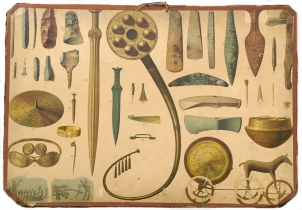
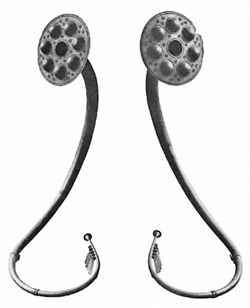
Josef Karl Gottfried was born in Rothau, Austrian town in 1822. He abbreviated his name to I.K. Gottfried. In 1857 Gottfried began working with Jacob Christian Fasting in 1857. That a partnership was established is suggested by instruments from that period marked Fasting & Gottfried, however that name does not appear in the Copenhagen city directory until 1880. Upon the death of J.C. Fasting in 1884, the company was carried on by Gottfried, and still bears his name today. I.K. Gottfried was known for his collaboration with Professor Angul Hammerich. Hammerich was very interested in the Bronze Age lurs found in different areas of Denmark, Norway, Sweden and Germany, but is considered typically Danish and regarded as symbols of Danish nationality (see photo at the top of this page). These instruments were molded with an extremely refined technique. Since the original instruments were too few and fragile to be used for extensive accousical testing and demonstration, Gottfried worked to make copies of of them which, for technical reasons, were made of coated brass. 'Aebleskive forehead' and the other decorations were placed close to the original design. In 1925, Prof. Hammerich held a lecture about the bronze lurs and had musicians demonstrate on the lurs. This was made into a recording on Nordisk Polyphon Aktieselskab at the National Museum, Copehagen (May 12th, 1925). The 78 rmp gramophone record was called 'Danmarks gamle lurer - tusindaarige toner'.
Johan Christoffer Selboe (1807-1873) was primarily a woodwind maker but also produced some brass intruments, flourishing in Copenhagen from 1837 until his death in 1873. He exhibited a keyed bugle and a tuba in Copenhagen in 1840.